
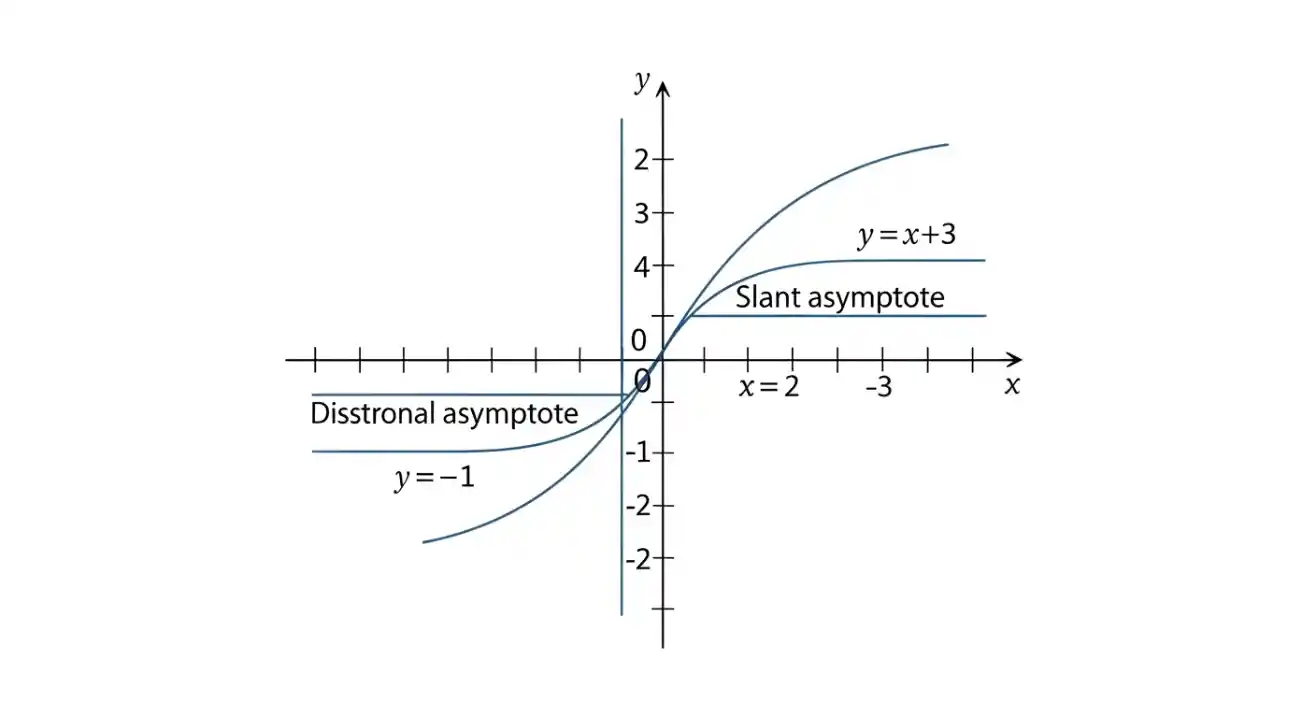

If you’ve ever looked at a graph and noticed a curve getting incredibly close to a line but never quite touching it, you’ve already seen an asymptote in action. Understanding horizontal, vertical, and slant asymptotes is one of those skills that unlocks a whole new level of confidence in algebra and calculus. Whether you’re a high school student, a college freshman, or someone brushing up on math, this guide breaks it all down in plain, simple terms.
What Is an Asymptote?
An asymptote is an imaginary line that a curve approaches but never actually reaches. Think of it like trying to walk halfway across a room, then halfway again, and again — you keep getting closer to the wall, but you technically never touch it.
There are three main types you’ll encounter:
- Horizontal asymptotes — lines the graph approaches as x moves toward infinity
- Vertical asymptotes — lines the graph approaches as y shoots toward infinity
- Slant (oblique) asymptotes — diagonal lines the graph approaches when neither horizontal nor vertical rules apply
Each one tells you something important about how a function behaves at its edges.
Horizontal, Vertical, and Slant Asymptotes Explained
Horizontal Asymptotes
A horizontal asymptote describes what happens to a function as x approaches positive or negative infinity. It’s all about the end behavior of the graph — where does the curve “settle” as you move far left or far right?
To find a horizontal asymptote in a rational function (one polynomial divided by another), compare the degrees of the numerator and denominator:
- If the degree of the numerator is less than the denominator → the horizontal asymptote is y = 0
- If both degrees are equal → divide the leading coefficients to get the asymptote
- If the numerator’s degree is greater → there is no horizontal asymptote (but there might be a slant one)
Example: For f(x) = 3x / (x + 2), both the numerator and denominator have degree 1. So the horizontal asymptote is y = 3/1 = y = 3.
Vertical Asymptotes
Vertical asymptotes occur where a function is undefined — typically where the denominator equals zero (and the numerator doesn’t also equal zero at that same point).
To find vertical asymptotes:
- Set the denominator equal to zero
- Solve for x
- Check that the numerator isn’t also zero at that value (which would make it a hole, not an asymptote)
Example: For f(x) = 1 / (x − 4), set x − 4 = 0, giving x = 4. The vertical asymptote is x = 4. The graph shoots up or down to infinity as it gets close to x = 4.
Denver Broncos vs Atlanta Falcons: What You Need to Know
Slant (Oblique) Asymptotes
Slant asymptotes appear when the degree of the numerator is exactly one more than the degree of the denominator. In this case, the graph doesn’t level off horizontally — it follows a diagonal path instead.
To find a slant asymptote, divide the numerator by the denominator using polynomial long division. The quotient (ignoring the remainder) gives you the equation of the slant asymptote.
Example: For f(x) = (x² + 2x + 1) / (x + 3), divide x² + 2x + 1 by x + 3. The result is x − 1 with a remainder. So the slant asymptote is y = x − 1.
Practical Examples in Real Problems
Let’s look at a slightly more involved example to tie everything together.
f(x) = (2x² − x) / (x² − 4)
- Vertical asymptotes: Set x² − 4 = 0 → x = 2 and x = −2
- Horizontal asymptote: Both numerator and denominator have degree 2. Divide leading coefficients: 2/1 = y = 2
- Slant asymptote: None — degrees are equal, so horizontal asymptote applies
Now try: g(x) = (x² + 5x) / (x − 1)
- Vertical asymptote: x = 1
- Horizontal asymptote: None — numerator degree (2) is greater than denominator degree (1)
- Slant asymptote: Divide x² + 5x by x − 1. Quotient is x + 6. So the slant asymptote is y = x + 6
Pros and Cons of Using Asymptotes to Analyze Functions
Pros
- Gives you a fast picture of a function’s overall behavior without plotting every point
- Helps identify undefined regions in a graph immediately
- Makes it easier to sketch rational functions accurately
- Essential for limits and calculus applications
Cons
- Asymptotes only describe behavior at extremes — they don’t tell you what happens in the middle of the graph
- Students often confuse holes with vertical asymptotes, which leads to errors
- Slant asymptotes require polynomial long division, which can be tricky without practice
- Some functions have unusual behavior that asymptotes alone can’t fully capture
Common Mistakes to Avoid
Even strong math students trip up on asymptotes. Here are the most frequent errors and how to sidestep them:
1. Confusing holes with vertical asymptotes If both the numerator and denominator equal zero at the same x value, it’s a hole — not an asymptote. Always factor and cancel first.
2. Assuming a graph never crosses an asymptote Horizontal asymptotes describe end behavior, but a graph can cross them in the middle. Many students think crossing is impossible — it’s not.
3. Skipping the degree check for slant asymptotes Slant asymptotes only exist when the numerator’s degree is exactly one more than the denominator’s. If the difference is two or more, you won’t get a slant asymptote.
4. Forgetting to simplify before finding asymptotes Always simplify the rational function first. Canceling common factors can eliminate what looked like a vertical asymptote and reveal a hole instead.
5. Getting the horizontal asymptote rule backwards Remember: if the numerator has a higher degree, horizontal asymptote doesn’t exist. Students sometimes mix this up and write y = 0 by mistake.
Best Practices for Finding Asymptotes
Follow these steps every time and you’ll rarely go wrong:
- Always factor first. Simplify the rational function before doing anything else.
- Compare degrees carefully. Write out the degrees of numerator and denominator explicitly before applying rules.
- Use long division for slant asymptotes. Don’t try to shortcut this step — do the full division.
- Check your vertical asymptotes. After setting the denominator to zero, plug the value back into the numerator to confirm it’s truly an asymptote and not a hole.
- Sketch the asymptotes first. When graphing, draw the asymptote lines as dotted guides before you sketch the curve.
- Verify with limits. If you have access to limit notation, confirm horizontal asymptotes by evaluating the limit as x → ∞ and x → −∞.
Conclusion
Asymptotes might seem abstract at first, but they’re really just a way of describing how functions behave at their limits. Once you get comfortable identifying horizontal, vertical, and slant asymptotes, graphing rational functions becomes far less intimidating. The key is to slow down, check your degrees, simplify before you start, and remember that each type of asymptote follows its own simple set of rules. Practice a few problems with these steps in mind, and it’ll click faster than you expect.
Frequently Asked Questions (FAQs)
1. Can a function have both a horizontal and a slant asymptote?
No. A rational function will have either a horizontal asymptote or a slant asymptote — not both. Horizontal asymptotes appear when the degrees are equal or the numerator’s degree is lower. Slant asymptotes appear only when the numerator’s degree is exactly one higher.
2. Is it possible for a graph to cross a vertical asymptote?
No. A function is undefined at a vertical asymptote, so the graph cannot cross it. The curve approaches it from one or both sides but never touches or crosses the line.
3. How do I know if it’s a hole or a vertical asymptote?
Factor both the numerator and denominator. If a factor cancels out, it creates a hole at that x value. If it doesn’t cancel, it creates a vertical asymptote.
4. Can a function have more than one vertical asymptote?
Yes, absolutely. A function can have as many vertical asymptotes as the denominator has distinct real roots. For example, f(x) = 1 / ((x−1)(x+2)) has vertical asymptotes at x = 1 and x = −2.
5. Do all rational functions have asymptotes?
Not necessarily. Some rational functions simplify to polynomials after canceling, which means they have no asymptotes at all. Also, if the denominator has no real roots, there are no vertical asymptotes — though horizontal or slant ones may still exist.
