
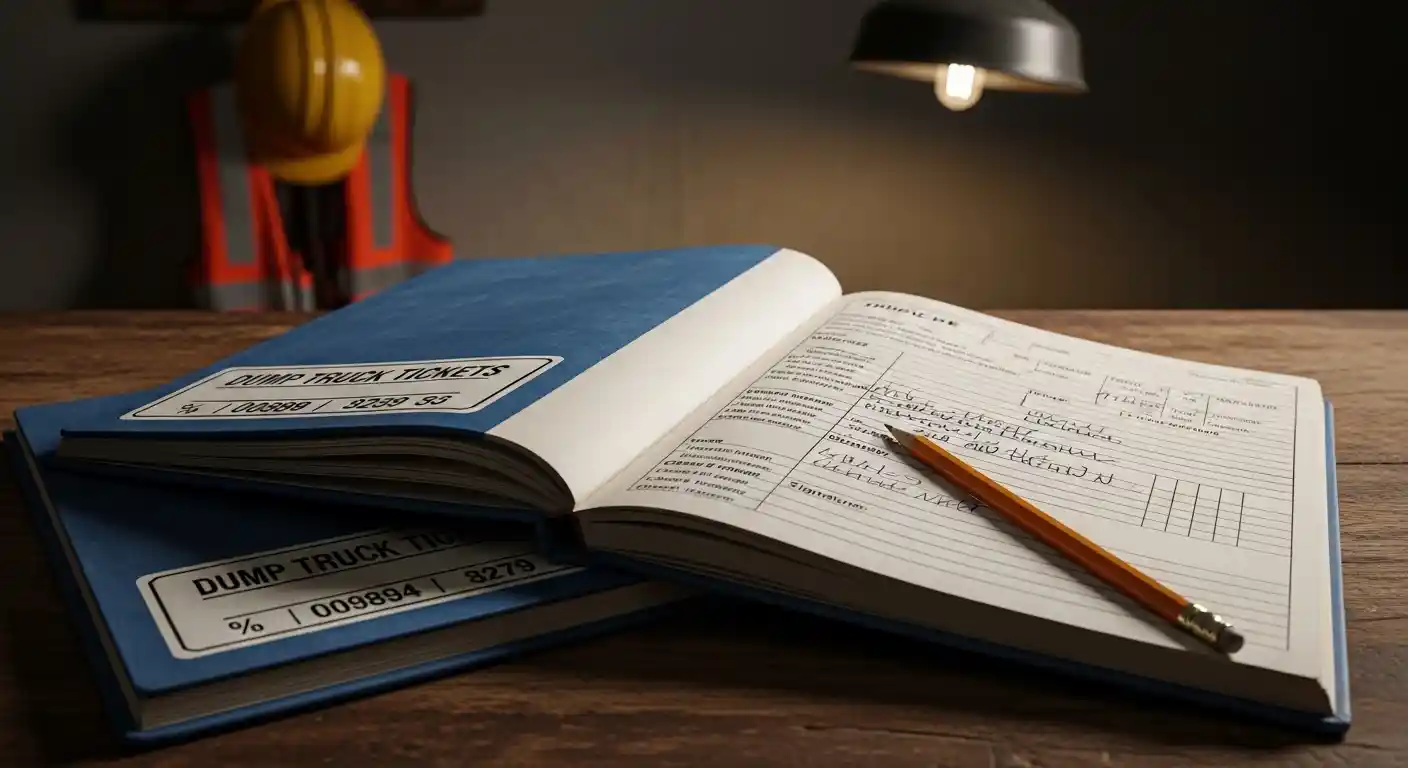

If you’ve ever managed a hauling job, you know how fast things can go sideways without proper documentation. Dump truck ticket books are one of the simplest tools on any job site — but skipping them is one of the most expensive mistakes contractors make. Whether you’re hauling dirt, gravel, asphalt, or demolition debris, these little books keep everyone honest and every load accounted for.
How Dump Truck Ticket Books Actually Work
At the core, a dump truck ticket book is a pre-numbered pad of load tickets. Each ticket documents a single haul — and when the job wraps up, your ticket stubs become your paper trail.
Here’s what a typical ticket captures:
- Date and job site location
- Driver name and truck number
- Material type being hauled
- Load count or tonnage
- Contractor or client name
- Signature lines for driver and site supervisor
Most books are duplicate or triplicate carbon copies. The driver keeps one, the site supervisor keeps one, and the hauling company retains the original. That three-way split is exactly what protects all parties if a billing dispute comes up later.
Why Job Sites Still Rely on Paper Tickets
Digital tracking exists — GPS, load sensors, fleet software — and yet paper dump truck ticket books are still everywhere. That’s not stubbornness. There’s a real reason.
They Work Without Cell Service
Remote construction sites, quarries, and rural road projects often have zero signal. A paper ticket doesn’t need Wi-Fi. It doesn’t crash. It doesn’t need charging. You fill it out, tear it off, and move on to the next load.
They Create Instant On-Site Verification
When a driver hands a signed ticket to the site supervisor on the spot, both parties are confirming the load in real time. There’s no syncing later. No data entry lag. The record exists the moment the load is delivered.
They Hold Up in Disputes
If a client questions the number of loads delivered or a subcontractor disputes payment, a stack of numbered, signed tickets is hard evidence. Courts and arbitrators take paper documentation seriously — especially when it’s pre-numbered and in sequence.
The Yellow Loverboy Hat: Style Guide & Where to Buy
Types of Dump Truck Ticket Books
Not all ticket books are the same. Choosing the right format saves time and confusion.
Duplicate Books (2-Part)
These give you an original and one copy. Best for smaller jobs where only two parties need records — typically the hauler and the contractor.
Triplicate Books (3-Part)
Adds a third copy for more complex jobs involving a general contractor, subcontractor, and owner. Very common on public works and government projects.
Custom-Printed Books
Many hauling companies order books with their logo, pre-filled company info, and job-specific fields. This speeds up the filling process and looks more professional to clients.
Carbonless vs. Carbon Paper
Older books used actual carbon paper between sheets. Modern versions use carbonless NCR paper — cleaner, no smudging, and the copies are sharper. Always go with carbonless if you have the choice.
Pros and Cons of Using Dump Truck Ticket Books
Pros
- Simple to use — no training or tech required
- Works anywhere — no connectivity needed
- Legal paper trail — holds up in billing disputes
- Low cost — a book of 50 tickets runs just a few dollars
- Instant confirmation — both parties sign on delivery
Cons
- Manual data entry later — someone has to tally tickets at the end of the day
- Easy to lose — a wet or muddy job site isn’t kind to paper
- No real-time visibility — the office doesn’t know load counts until tickets come in
- Human error — handwriting mistakes or missed fields happen
Common Mistakes Contractors Make with Ticket Books
Even experienced crews mess this up. Here are the mistakes that cause the most headaches:
Not numbering loads sequentially. Pre-numbered books solve this, but if someone skips a ticket or uses books out of order, reconciling loads becomes a nightmare. Always start a new book from ticket #1 on each job.
Skipping signatures. A ticket without a supervisor signature is nearly worthless in a dispute. Make it a hard rule — no signature, no valid delivery.
Storing tickets loose in the truck cab. Tickets get lost, wet, or blown out of windows. Drivers should hand off their copy to a job site contact or lock it in a document holder immediately.
Using generic tickets with missing fields. If your ticket doesn’t capture truck number, material type, or tonnage, you’re leaving room for disputes. Use books with all critical fields printed.
Not reconciling daily. Waiting until the end of a two-week job to count tickets is asking for trouble. Do a quick count every day and flag any gaps immediately.
Best Practices for Managing Dump Truck Ticket Books
Follow these habits and you’ll rarely have a billing problem:
Assign one book per truck per job. This keeps records clean and makes it easy to track each driver’s loads independently.
Use waterproof document pouches. Mud, rain, and spilled coffee are constants on job sites. A $2 plastic sleeve protects weeks of documentation.
Photograph tickets at the end of each day. Take a quick phone photo of the day’s stack before handing them in. It’s a backup that takes 30 seconds and can save thousands in disputes.
Match tickets to invoices before billing. Never send an invoice based on memory or estimates. Count your tickets, verify the total, then bill. Your client will trust you more, and you’ll catch shortfalls before they become arguments.
Order custom books for recurring clients. If you’re hauling for the same GC every month, a book with pre-filled job info signals professionalism and reduces errors at the same time.
A Practical Example: How Tickets Prevent Overpayment
Say a hauling company runs eight trucks over three days on a grading project. Without tickets, the contractor relies on the driver’s verbal count and a rough GPS log. At billing, the contractor claims 140 loads. The client thinks it was closer to 120.
With a triplicate ticket book, every load has a numbered ticket, a driver signature, and a site supervisor sign-off. At the end of the job, both sides count their stubs. If there are 138 tickets with matching signatures, that’s the number — no argument, no compromise, no bad blood.
That’s the whole value. Not just accuracy. Trust.
Conclusion
Dump truck ticket books aren’t glamorous. They’re not a tech solution. But they solve a real problem — and they solve it reliably, cheaply, and without any learning curve. Whether you’re managing a small landscaping haul or a major earthmoving contract, keeping clean ticket records protects your revenue and your reputation. The jobs that skip the paperwork are always the ones that end in a phone call nobody wants to make.
FAQs
1. What is a dump truck ticket book used for?
It’s used to document each load a dump truck hauls on a job site, capturing details like material type, driver info, load count, and signatures. It serves as the billing and verification record for the job.
2. How many tickets are usually in a dump truck ticket book?
Most standard books contain 50 to 100 pre-numbered tickets. Custom books can be ordered in larger quantities depending on job volume.
3. Are carbonless ticket books better than carbon paper ones?
Yes. Carbonless NCR paper produces cleaner copies, doesn’t smudge, and is easier to read — especially in field conditions where hands are dirty and lighting isn’t great.
4. Can I use dump truck tickets for any material type?
Absolutely. They’re used for dirt, gravel, sand, asphalt, concrete debris, topsoil, and demolition waste. The material field on the ticket is simply filled in per load.
5. How long should I keep dump truck ticket stubs after a job?
Most contractors keep records for three to seven years depending on local regulations and contract terms. For any job involving government or public contracts, check the specific retention requirements before discarding anything.
