

You’ve probably been there: staring at your calendar, sweating because you aren’t sure if that 9:00 AM Los Angeles meeting is happening in your morning or your afternoon. Or perhaps you’ve dialed into a conference call an hour early—or worse, an hour late—because someone forgot about the “Spring Forward” shift.
Managing the America/California time zone shouldn’t feel like solving a complex calculus equation. Whether you are a remote worker trying to sync with a Silicon Valley team, a traveler planning a trip to Yosemite, or a business owner shipping goods to Long Beach, getting the timing right is the difference between a smooth day and a professional nightmare. This guide clears the fog and gives you the exact tools to master California time.
What is the America/California Time Zone?
When people talk about California time, they are officially referring to the Pacific Time Zone. In the world of computers and database management (like the IANA Time Zone Database), you will often see it labeled as America/Los_Angeles.
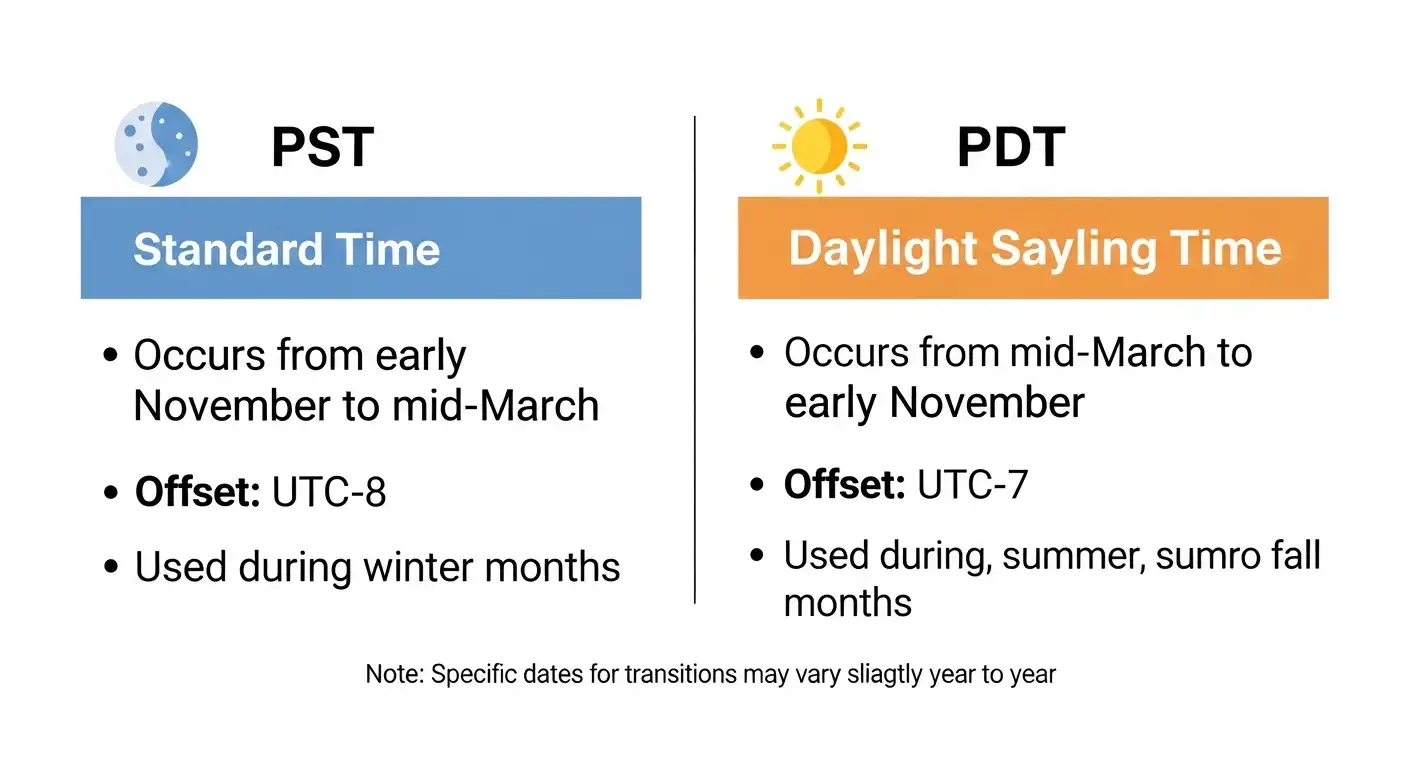
California does not stay on one single offset all year. It alternates between two specific “modes” to maximize daylight. For most of the year, California operates on Pacific Daylight Time (PDT), which is 7 hours behind Coordinated Universal Time ($UTC-7$).
During the winter months, the state shifts to Pacific Standard Time (PST). During this period, the state is 8 hours behind Coordinated Universal Time ($UTC-8$). Understanding this toggle is the most important part of keeping your schedule accurate.
California Time Explained with a Real Scenario
Imagine you are a freelance designer based in London, and your biggest client is a tech startup in San Francisco. It’s mid-July. Since London is on British Summer Time ($UTC+1$) and California is on Pacific Daylight Time ($UTC-7$), there is an 8-hour gap between you.
If your client asks for a “sync at 10:00 AM our time,” you need to realize that your workday is actually ending just as theirs is beginning. By 10:00 AM in San Francisco, it is 6:00 PM in London.
However, if that same meeting happens in December, both regions have shifted. London is on GMT ($UTC+0$) and San Francisco is on PST ($UTC-8$). The gap remains 8 hours, but the “feel” of the day changes because the sun sets much earlier for both of you. Knowing the offset is only half the battle; knowing the “overlap” is how you actually get work done.
12 PM Pacific Time in Eastern Time: The Definitive Guide
How to Calculate California Time Step-by-Step
If you don’t want to rely on a website every time you need to check the clock, follow this simple mental framework to calculate the time in California:
-
Identify the current date: Determine if it falls between the second Sunday in March and the first Sunday in November. If it does, California is in Daylight Saving Time (PDT).
-
Find your local UTC offset: Know your own city’s relationship to the prime meridian. (e.g., New York is $UTC-5$ in summer, $UTC-4$ in winter).
-
Subtract the difference: If you are in New York (EDT) and it is 12:00 PM, you know New York is $UTC-4$ and California is $UTC-7$. The math is $7 – 4 = 3$.
-
Apply the result: Since California is further west, it is “behind” you. Subtract those 3 hours. 12:00 PM minus 3 hours equals 9:00 AM in California.
-
Double-check the “Shift Dates”: Always be extra cautious during the transition weeks in March and November, as other countries change their clocks on different schedules than the United States.
Common Mistakes People Make
The most frequent error is using the terms “PST” and “PDT” interchangeably. While it might seem like pedantry, using the wrong acronym in a legal contract or a flight itinerary can cause genuine confusion. PST is for winter; PDT is for summer.
Another major pitfall is the “Arizona Exception.” California’s neighbor to the east, Arizona, does not observe Daylight Saving Time. This means that for half the year, California and Arizona are on the same time, and for the other half, they are an hour apart. If your travel route crosses the state line, never assume your phone will update instantly.
Finally, many people forget that the America/California time zone shift happens at 2:00 AM. If you are working a night shift or catching a red-eye flight on the transition Sunday, that “missing” or “extra” hour occurs right in the middle of the night, not at midnight.
California Time (Pacific) vs. Other Major US Zones
To keep your bearings, it helps to see how California stacks up against its neighbors and colleagues across the country.
| Time Zone Name | Standard Offset | Daylight Offset | Comparison to California |
| Pacific (California) | UTC-8 | UTC-7 | The Baseline |
| Mountain Time | UTC-7 | UTC-6 | 1 Hour Ahead |
| Central Time | UTC-6 | UTC-5 | 2 Hours Ahead |
| Eastern Time | UTC-5 | UTC-4 | 3 Hours Ahead |
| Alaska Time | UTC-9 | UTC-8 | 1 Hour Behind |
| Hawaii Time | UTC-10 | UTC-10 (No DST) | 2-3 Hours Behind |
Pro Tips for Managing the California Time Zone
If you deal with California frequently, you need more than just a clock; you need a strategy. Automation is your best friend. Set your digital calendar (like Google Calendar or Outlook) to display a secondary time zone. This puts a California “ruler” right next to your local time, allowing you to see overlaps visually.
For those managing teams, respect the “Golden Window.” The Golden Window for California and the East Coast (New York) is between 9:00 AM and 2:00 PM PST. This is when both coasts are at their desks and fully caffeinated. If you are in Europe, your Golden Window with California is much smaller, usually between 8:00 AM and 10:00 AM PST (which is late evening in Europe).
Leverage “Asynchronous Communication” if the time gap is too large. Instead of forcing a 10:00 PM meeting for one party, use video messaging tools or detailed project management boards. This removes the “time zone tax” from your productivity.
Frequently Asked Questions
Does all of California use the same time zone? Yes, the entire state of California follows the Pacific Time Zone. Unlike some states (like Oregon or Idaho) that are split between two zones, California is unified from the Oregon border down to Mexico.
When does California change its clocks? California follows the US federal schedule. Clocks “Spring Forward” one hour on the second Sunday in March and “Fall Back” one hour on the first Sunday in November.
Is California trying to end Daylight Saving Time? There have been several legislative attempts and voter initiatives (like Proposition 7) to move California to permanent Daylight Saving Time. However, this requires federal approval, so for now, the twice-a-year switch remains the law.
What is the “America/Los_Angeles” identifier? This is the “tz database” name used by software developers and operating systems. If you are setting up a website or a server to display California time, this is the string you would typically use in your code.
What is the best way to coordinate a meeting with someone in California? The most effective way is to use a “Find a Time” feature in your calendar app or send a link from a scheduling tool. This automatically adjusts for the recipient’s local time, eliminating the risk of manual math errors.
The Secret Insight: The “Transition Week” Trap
One thing most guides miss is the International Transition Gap. If you are coordinating between California and the UK or Europe, there is a two-to-three-week period in March and October/November where the time difference actually changes.
The US typically starts Daylight Saving earlier in the spring and ends it later in the fall than Europe. During those weeks, the 8-hour gap might shrink to 7 hours or expand to 9 hours. If you have recurring weekly meetings, always manually verify the calendar during the last week of March and the last week of October.
Understanding the America/California time zone is about more than just knowing what time it is; it’s about understanding the rhythm of the West Coast. California is the hub of global tech and entertainment, and its clock dictates the pace of massive industries.
By mastering these offsets and avoiding common nomenclature mistakes, you position yourself as a reliable professional who is always on time. Your next step: Open your calendar settings right now and add “Los Angeles” as a secondary time zone. It takes ten seconds and will save you hours of future frustration.
