
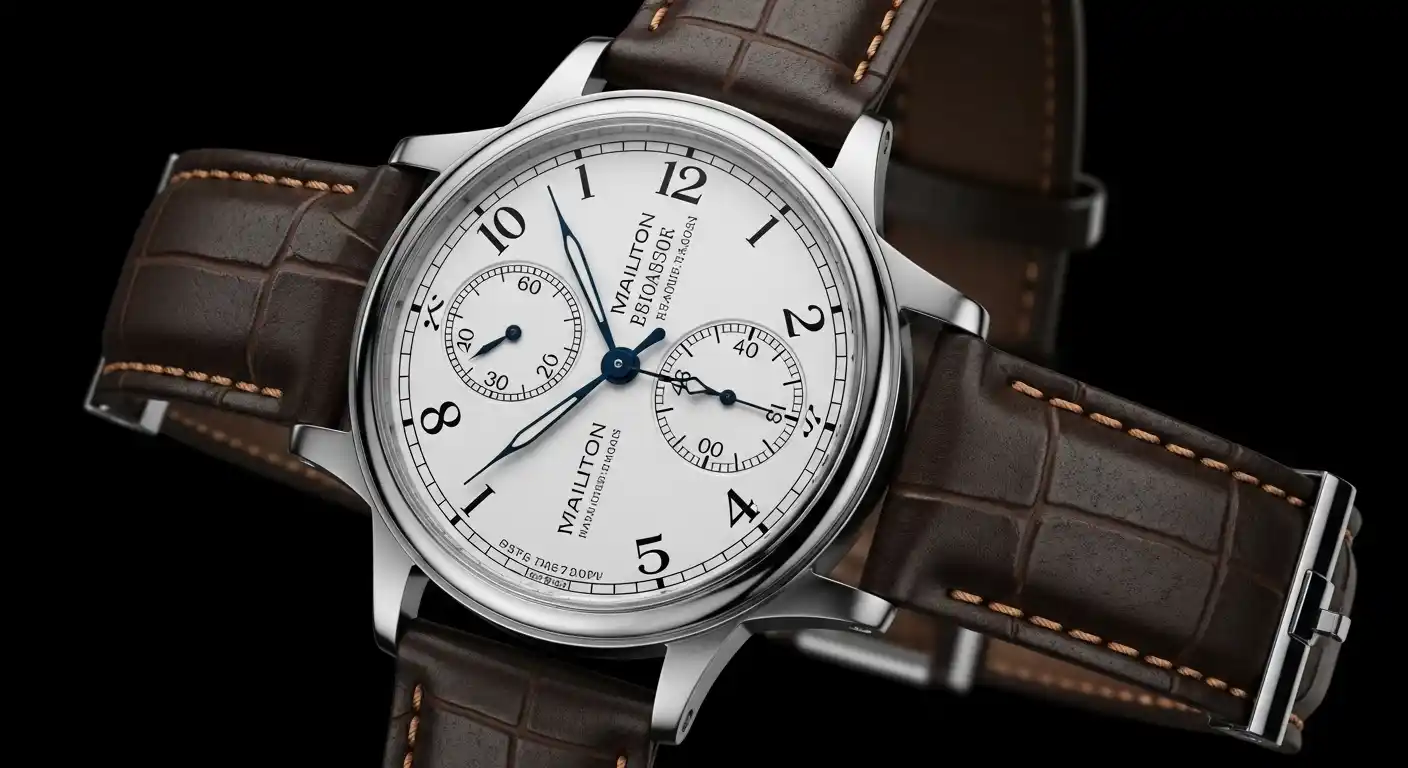

There’s something special about a watch brand that has timed both train departures and movie scenes. Hamilton watch history stretches back over 130 years, weaving through American railroads, military service, Hollywood blockbusters, and Swiss precision. If you’ve ever wondered how one brand managed to stay relevant across so many eras, you’re about to find out.
The Origins: Born in Lancaster, Pennsylvania
Hamilton Watch Company was founded in 1892 in Lancaster, Pennsylvania. The city wasn’t chosen by accident. Lancaster sat at the heart of American railroad country, and the railroads desperately needed reliable timekeeping.
Before Hamilton came along, inconsistent watches were actually causing deadly train collisions. Engineers and conductors needed watches they could trust with their lives — and with other people’s lives.
Hamilton stepped up and delivered exactly that.
The Railroad Grade Standard
In 1893, a catastrophic rail accident in Ohio pushed the American railroad industry to establish strict timekeeping standards. Hamilton’s watches became the go-to choice for meeting those standards.
Their railroad-grade pocket watches were required to:
- Keep time within 30 seconds per week
- Have a white dial with bold black numbers
- Feature open-face cases for quick reading
- Be adjusted to at least five positions
This wasn’t just marketing. Lives depended on every second.
Hamilton Goes to War — Twice
When World War I broke out, the U.S. military needed reliable field watches. Hamilton shifted focus and began producing watches for soldiers. Accuracy in the trenches wasn’t optional — it was survival.
Then World War II arrived, and Hamilton went all in. The company stopped making civilian watches entirely between 1942 and 1945. Every single watch produced during that period went to the military.
What They Made During WWII
Hamilton produced an impressive range of military instruments during the war years:
- Wristwatches for officers and enlisted men
- Marine chronometers for naval navigation
- Deck watches for surface vessels
- Aviation instruments for pilots
Their Model 21 and Model 22 marine chronometers were so accurate that they were used by the U.S. Navy well into the 1960s. That’s not just quality — that’s a legacy.
The Electric Revolution: Hamilton Changes the Game
Here’s where Hamilton’s story gets genuinely fascinating. In 1957, the company launched the Hamilton Electric 500 — the world’s first electric watch.
No winding. No crown. Just a small battery powering the movement.
It sounds ordinary now, but in 1957 it was revolutionary. Watch lovers and tech enthusiasts were stunned. The Hamilton Electric put the brand on the global map in a completely new way.
Classroom 15: Setup, Tips & Best Practices Guide
The Ventura: A Watch Born for the Space Age
The same year as the Electric 500, Hamilton introduced the Ventura. Designed by industrial designer Richard Arbib, the Ventura had a triangular, asymmetrical case that looked like it belonged in a science fiction film.
It actually ended up in one. Elvis Presley wore the Ventura in the 1961 film Blue Hawaii, and suddenly every watch enthusiast in America wanted one.
The Ventura remains in Hamilton’s catalog today. That kind of longevity says everything.
Hamilton Watch History and Hollywood: A Natural Partnership
Speaking of movies, few watch brands have a deeper relationship with cinema than Hamilton. Since the 1930s, Hamilton watches have appeared in over 500 films. That’s not a coincidence — it’s a strategy.
Notable Film Appearances
Some of the most memorable Hamilton moments on screen include:
- Men in Black (1997) — Will Smith wore a custom Hamilton Ventura
- Interstellar (2014) — The Hamilton Murph watch played a central role in the plot
- 2001: A Space Odyssey (1968) — Hamilton watches appeared throughout Kubrick’s masterpiece
- The Martian (2015) — Matt Damon’s character relied on a Hamilton on Mars
The Interstellar partnership with Christopher Nolan is particularly noteworthy. Hamilton and the film’s team worked together to design a watch that was actually woven into the storyline. That’s not product placement — that’s storytelling through a timepiece.
The Swiss Chapter: Hamilton Joins the Swatch Group
In 1974, Hamilton moved its watchmaking operations to Biel, Switzerland. It was a major shift. American manufacturing gave way to Swiss precision, and Hamilton gained access to some of the finest watchmaking infrastructure in the world.
Then in 1983, Hamilton became part of the Swatch Group — the world’s largest watch conglomerate. Some fans worried the brand would lose its identity. Instead, Hamilton used the resources to grow stronger.
Today, Hamilton still designs and assembles watches in Biel, and the American spirit of the brand remains front and center in its marketing and design language.
Pros and Cons of Owning a Hamilton Watch
Pros:
- Deep, genuine history that adds real meaning to ownership
- Excellent value compared to similarly specced Swiss competitors
- Wide range of styles — from military-inspired to dress watches
- Strong resale value within the mid-range segment
- In-house and ETA movements with solid reliability
Cons:
- No longer manufactured in the United States, despite American branding
- Some collectors feel the brand identity has softened under Swatch Group ownership
- Mid-range pricing can feel steep compared to Japanese alternatives with similar specs
- Limited availability of truly rare or collectible vintage pieces at accessible prices
Common Mistakes When Buying a Hamilton Watch
A lot of buyers make avoidable errors when shopping for a Hamilton. Here’s what to watch out for:
1. Ignoring the movement details Hamilton offers both ETA-based and in-house movements. The Caliber H-10, for example, is an in-house movement with an impressive 80-hour power reserve. Always check what’s inside before buying.
2. Overlooking vintage authenticity Vintage Hamilton pocket watches are widely faked or modified. If you’re buying vintage, always request service records and examine the dial, hands, and case for period-correct details.
3. Buying purely for the Hollywood connection The film editions are fun, but they’re often priced at a premium for the story alone. If you want a daily wearer, focus on the movement and case specs rather than the movie tie-in.
4. Skipping authorized dealers Gray market Hamilton watches can be genuine, but you lose warranty coverage. For a first Hamilton purchase, stick with authorized retailers.
Best Practices for Hamilton Watch Enthusiasts
Whether you’re buying your first Hamilton or adding to a collection, these habits will serve you well:
- Research the specific reference number before purchasing — Hamilton’s lineup is large and some models share similar names with different movements.
- Service regularly — most mechanical Hamilton watches benefit from a service every 5–7 years to keep accuracy and longevity strong.
- Store properly — keep your watch away from magnets, extreme temperatures, and humidity.
- Join collector communities — forums like WatchUSeek and Reddit’s r/Watches have dedicated Hamilton threads with genuine expertise.
- Hold onto original boxes and papers — they significantly impact resale value, especially for limited editions.
Conclusion
Hamilton’s journey from Lancaster railroad depots to Swiss workshops and Hollywood soundstages is one of the most compelling stories in watchmaking. The brand didn’t just survive changing times — it helped define them. Whether it was keeping trains on schedule, guiding sailors through wartime, or ticking on the wrist of an astronaut in a Christopher Nolan film, Hamilton has always been where the action is.
If you’re looking for a watch with genuine soul, real history, and strong everyday credentials, Hamilton deserves a serious look. There aren’t many brands that can honestly say they helped build a nation’s railroad system. Hamilton can.
Frequently Asked Questions
1. When was Hamilton Watch Company founded?
Hamilton was founded in 1892 in Lancaster, Pennsylvania, primarily to serve the American railroad industry with highly accurate pocket watches.
2. Is Hamilton still an American watch brand?
Hamilton has American roots and identity, but manufacturing moved to Biel, Switzerland in 1974. The brand is now part of the Swiss Swatch Group.
3. Why are Hamilton watches associated with movies?
Hamilton has been supplying watches for Hollywood productions since the 1930s. Their designs photograph well and carry a strong visual identity, making them popular with costume designers and directors.
4. What is the most iconic Hamilton watch ever made?
Many collectors point to the Hamilton Ventura, introduced in 1957, as the most iconic model. Its asymmetrical case design and connection to Elvis Presley cemented its legendary status.
5. Are Hamilton watches a good investment?
Hamilton watches hold value reasonably well within the mid-range segment, particularly limited editions and vintage railroad-grade pieces. However, they’re better appreciated as wearable history than pure financial investments.
