

You’re staring at your calendar, and your stomach drops. You just realized that the “9:00 AM” meeting your New York client booked is actually 6:00 AM for you in Seattle. Or perhaps you’re on the East Coast, waiting for a “quick sync” at 5:00 PM, only to realize your California colleague won’t even be back from lunch for another hour.
Navigating the PST time vs EST time divide is the silent killer of productivity. It leads to missed calls, groggy morning presentations, and the frustration of “playing phone tag” across three thousand miles. You don’t need a math degree to get it right; you just need a system that works every time. This guide is your roadmap to never making a time zone blunder again.
What is PST Time and EST Time?
When we talk about PST time and EST time, we are looking at the two coastal anchors of North American business. Pacific Standard Time (PST) is the heartbeat of the West Coast, covering hubs like Los Angeles, San Francisco, and Vancouver. On the opposite side of the continent, Eastern Standard Time (EST) governs the financial and political powerhouses like New York City, Toronto, and Washington, D.C.
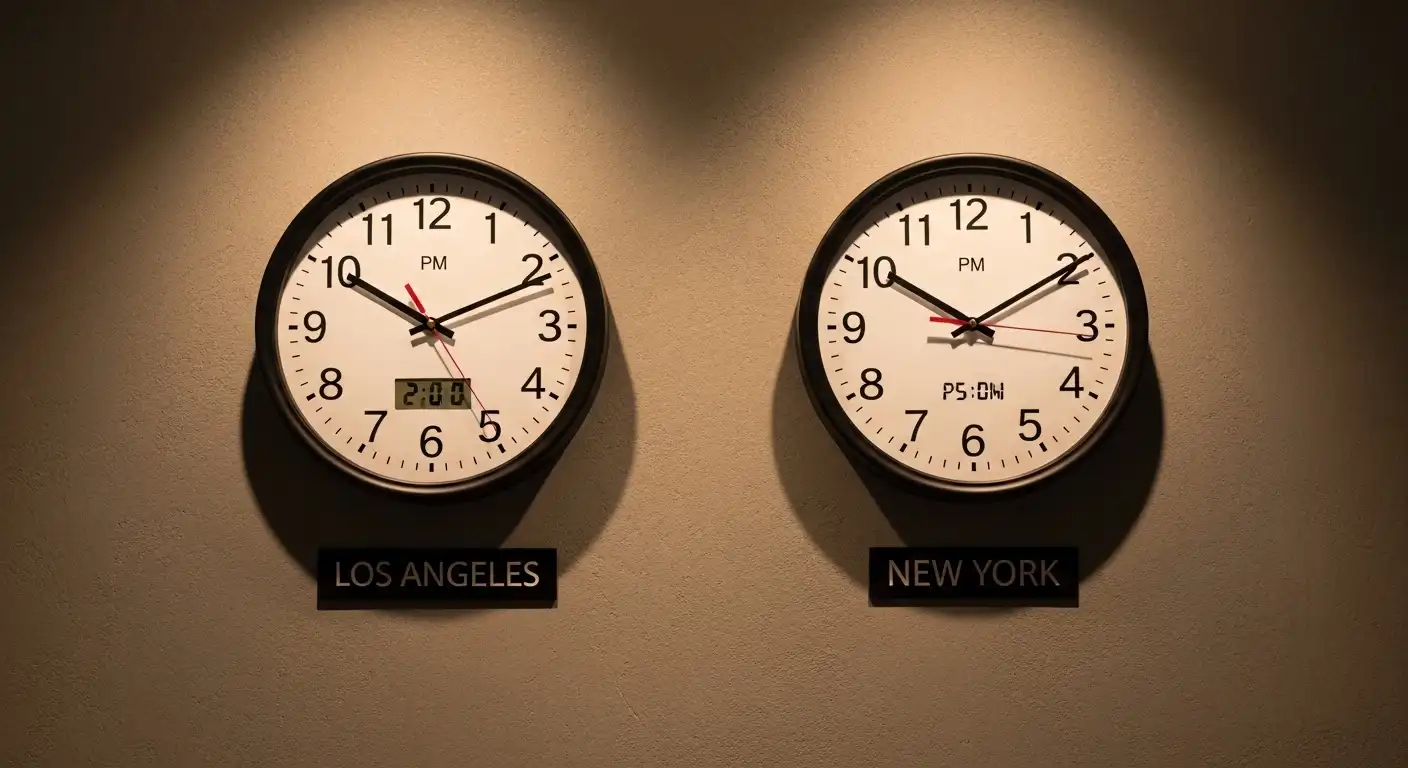
The most important number to memorize is three. The Eastern time zone is exactly three hours ahead of the Pacific time zone. When a New Yorker is finishing their morning coffee at 11:00 AM, a Californian is likely just hitting the “snooze” button for the first time at 8:00 AM.
However, there is a catch: Daylight Saving Time (DST). Most of North America shifts to “Daylight” versions of these zones (PDT and EDT) from March to November. While the three-hour gap usually stays the same, the labels change. If you are communicating with someone in a region that doesn’t observe DST (like parts of Arizona), the math can shift to a two-hour or four-hour gap depending on the season.
PST Time vs EST Time: A Real-World Collaboration Scenario
Imagine you are a freelance graphic designer based in Los Angeles (PST). You land a massive contract with a marketing agency in Miami (EST).
The agency director says, “Let’s touch base at 2:00 PM our time on Tuesday.” If you simply put “2:00 PM” on your calendar without checking the zone, you are going to be three hours late. By the time 2:00 PM rolls around in LA, it’s already 5:00 PM in Miami—and your client is likely heading out the door for the day.
To make this work, you have to “translate” the time immediately. You subtract three hours from their 2:00 PM. Now you know you need to be at your desk and ready at 11:00 AM sharp. Always confirm the “translation” in your reply. A simple “See you at 2:00 PM EST / 11:00 AM PST” eliminates any room for error.
Racing Games Unblocked: The Best Sites and Fast Play Guide
How to Calculate the Time Difference: Step-by-Step
Calculating the difference between PST time and EST time doesn’t have to be a guessing game. Follow these steps to ensure you’re always on the same page as your colleagues.
-
Identify the Base Time: Start with the time provided by the host or the person requesting the meeting.
-
Determine the Direction: Are you moving East (adding time) or West (subtracting time)?
-
Apply the Three-Hour Rule: * If you have the PST time and need EST, add 3 hours.
-
If you have the EST time and need PST, subtract 3 hours.
-
-
Verify the Date: If a meeting is scheduled late at night (e.g., 10:00 PM PST), the EST time will actually be 1:00 AM the next day.
-
Use a Digital Double-Check: Before sending that invite, use a “World Clock” feature on your smartphone or a site like TimeAndDate to confirm your mental math.
Common Mistakes People Make with PST and EST
The biggest mistake is assuming everyone is on your clock. It sounds simple, but “Main Character Syndrome” in time zones causes thousands of missed appointments daily. If you send an invite that says “Meeting at 4:00” without a suffix, you are setting yourself up for failure.
Another frequent error is ignoring the “Overlap Window.” There is a very specific window of time where both coasts are actually at their desks. If you schedule a meeting at 9:00 AM EST, your West Coast team is likely asleep. If you schedule it at 4:30 PM PST, your East Coast team has already started their evening commute.
Finally, people often forget about Arizona and Hawaii. Arizona stays on Mountain Standard Time year-round. This means that for half the year, they align with PDT (Pacific Daylight), and for the other half, they are an hour ahead. If your team is spread across these specific regions, the “standard” three-hour rule might betray you.
PST vs EST: Comparison at a Glance
| If it is this time in PST | It is this time in EST | Typical Activity (Business Context) |
| 6:00 AM | 9:00 AM | EST starts their day; PST is still asleep. |
| 8:00 AM | 11:00 AM | The “Golden Window” begins. Both coasts are online. |
| 9:00 AM | 12:00 PM | EST takes lunch; PST is in deep work. |
| 12:00 PM | 3:00 PM | Both coasts are back from lunch; peak meeting time. |
| 2:00 PM | 5:00 PM | The “Golden Window” ends. EST is signing off. |
| 5:00 PM | 8:00 PM | PST is finishing up; EST is in “personal time.” |
Pro Tips for Managing the 3-Hour Gap
To truly excel in a cross-coastal environment, you need to go beyond simple math. You need to adopt a “Time Zone First” mindset.
Set Dual Clocks on Your Desktop
Most operating systems (Windows and macOS) allow you to show two or three different clocks in your taskbar or menu bar. Set one to your local time and the other to the opposite coast. Seeing “5:00 PM” in New York while it’s only 2:00 PM for you serves as a constant visual reminder of your colleagues’ reality.
Standardize Your Communication
Develop a habit of always including both time zones in written communication. Instead of saying “Let’s talk at 1,” write “Let’s talk at 1:00 PM PST / 4:00 PM EST.” This shows high emotional intelligence and respect for the other person’s schedule.
Respect the “Quiet Hours”
Just because you are working doesn’t mean they should be. Avoid sending “urgent” Slack messages or texts to an East Coast colleague at 5:00 PM PST (8:00 PM EST) unless it is a true emergency. Use “Scheduled Send” features in your email or messaging apps to ensure your 4:00 PM Pacific thoughts arrive in their inbox at 9:00 AM Eastern the next day.
Frequently Asked Questions
Is PST always 3 hours behind EST?
Yes, in the vast majority of cases, the gap remains exactly three hours. The only time this fluctuates is during the very brief windows when Daylight Saving Time begins or ends, as some regions may transition a few hours or days differently than others (though this is rare within the US and Canada).
What states are in PST?
The primary states in Pacific Standard Time include California, Washington, Oregon, and Nevada. Parts of Idaho also observe Pacific time.
Does the 3-hour difference apply to Canada?
Yes. Major Canadian cities like Vancouver (PST) and Toronto (EST) follow the same three-hour difference and observe Daylight Saving Time on the same schedule as the United States.
When does PST change to PDT?
Daylight Saving Time typically begins on the second Sunday in March and ends on the first Sunday in November. During this time, “Standard Time” (PST/EST) becomes “Daylight Time” (PDT/EDT).
How do I schedule a meeting for both PST and EST teams?
The “sweet spot” is usually between 9:00 AM and 2:00 PM PST, which translates to 12:00 PM to 5:00 PM EST. This ensures no one has to wake up too early or stay too late.
The “Secret” Insight: The Energy Gap
Most articles tell you how to calculate the time, but they don’t tell you about the Energy Gap. Because the East Coast starts three hours earlier, they are often in “wrap-up mode” while the West Coast is in “high-energy mode.”
By 2:00 PM PST, a California worker is often at their peak productivity for the afternoon. However, their New York counterpart at 5:00 PM EST is likely experiencing “decision fatigue” and is ready to disconnect. When scheduling high-stakes negotiations or complex brainstorming sessions, try to aim for the 11:00 AM EST / 8:00 AM PST slot. Even though it’s early for the West Coast, both parties are generally fresher and more alert.
Mastering the Clock
Managing the PST time to EST time difference is more than just an administrative task—it’s a mark of professionalism. By respecting the three-hour gap, using clear communication, and utilizing the “Golden Window,” you can eliminate the friction that often plagues remote and cross-country teams.
The next time you reach for your calendar, don’t just pick a number. Think about the person on the other end of the line. Are they just starting their day, or are they trying to get home to their family?
