

You’re staring at an invite for a “10:00 AM PST” meeting, and your brain immediately starts doing frantic gymnastics. Is that 1:00 PM for you? Or did the West Coast already move their clocks forward? You check your phone, then your laptop, and suddenly you’re terrified of showing up an hour late—or awkwardly early—to a high-stakes interview. We’ve all been there, sitting in that “time zone limbo” where a simple calculation feels like solving a calculus equation while caffeinated.
This isn’t just about numbers on a clock; it’s about your reputation, your sleep schedule, and your sanity. Missing a window because you didn’t grasp the time zone of PST can cost you a client or a job. This guide is designed to strip away the jargon and give you a foolproof way to handle Pacific Time without the headache.
What is the Time Zone of PST?
In plain English, PST stands for Pacific Standard Time. It is the “baseline” time used by the western part of North America, including major hubs like Los Angeles, Vancouver, and Seattle.
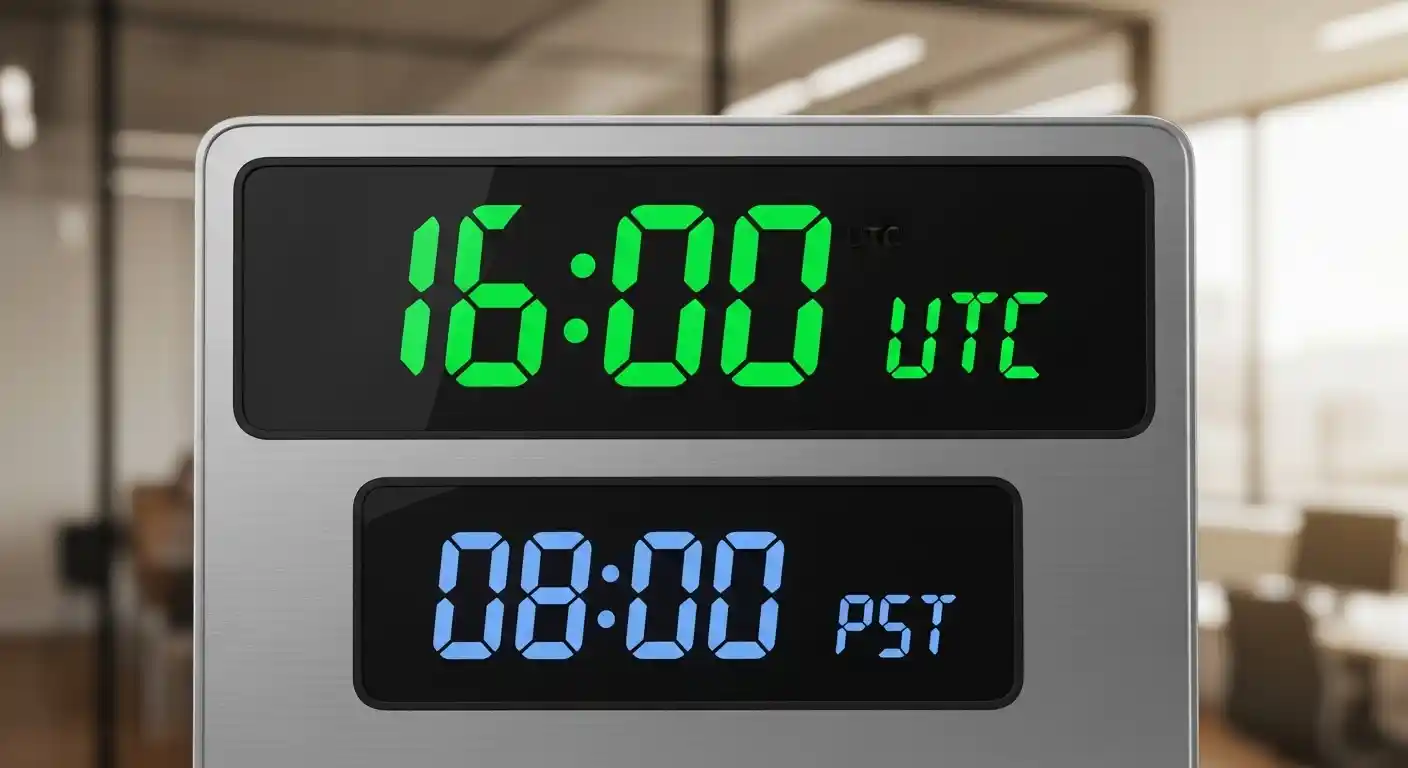
When people ask about the time zone of PST, they are usually looking for its relationship to the rest of the world. Geographically, it sits eight hours behind Coordinated Universal Time (UTC). If the world’s “master clock” in London says it is 8:00 PM, the West Coast is just starting its morning at 12:00 PM.
The most important thing to remember is that PST is a “Standard” time. This means it is technically only in effect during the winter months. If you are trying to coordinate a meeting in the middle of July, you aren’t actually using PST—you’re using its cousin, PDT (Pacific Daylight Time).
California Time Zone Guide: Pacific Time Secrets for Success
The Time Zone of PST Explained with a Real Scenario
Imagine you are a freelance designer based in New York (Eastern Time). You land a massive contract with a tech firm in San Francisco. The project manager says, “Let’s hop on a sync at 2:00 PM PST on Tuesday.”
If you simply add three hours because “California is behind,” you might get it right—unless it’s March. During the transition into Daylight Saving Time, if you don’t account for the “Standard” vs. “Daylight” labels, you could easily find yourself sitting in an empty Zoom room.
In this scenario, the time zone of PST acts as the anchor. Because New York is five hours behind UTC and San Francisco is eight hours behind, there is a consistent three-hour gap. When it’s 2:00 PM for them, it’s 5:00 PM for you. Understanding this gap is the difference between finishing your workday on time and having your dinner interrupted by a “Where are you?” Slack message.
How to Calculate and Use Pacific Time: Step-by-Step
Navigating time differences doesn’t require a math degree. Follow these three steps to ensure you never miss a beat:
-
Identify the Base Offset: Start by knowing that PST is UTC-8. This is your magic number. If you know the current UTC (which stays constant), just subtract eight hours.
-
Check the Season: Ask yourself, “Is it winter?” In the United States and Canada, PST runs from the first Sunday in November to the second Sunday in March. Outside of those dates, you are likely dealing with PDT (UTC-7).
-
Use a Reference City: If the math gets fuzzy, pick a major city in that zone. Los Angeles is the gold standard. Google “Time in Los Angeles” to instantly see if your manual calculation matches the current reality.
Common Mistakes People Make
The biggest blunder is using the term “PST” as a catch-all for Pacific Time year-round. While most people will know what you mean, using “PST” in July is technically incorrect and can lead to confusion with international partners who follow different Daylight Saving rules.
Another mistake is forgetting that not every region in the Pacific corridor observes Daylight Saving. While California and Washington flip their clocks, some nearby regions or specific international territories might stay on Standard time indefinitely.
Finally, people often confuse PST with MST (Mountain Standard Time). Remember: PST is the furthest west you can go in the contiguous United States. If you are moving toward the Atlantic, you are adding hours, not subtracting them.
PST vs. PDT: The Essential Comparison
Understanding the time zone of PST requires knowing its relationship with PDT. Many people use these interchangeably, but they are distinct phases of the same geographic region.
| Feature | Pacific Standard Time (PST) | Pacific Daylight Time (PDT) |
| UTC Offset | UTC-8 | UTC-7 |
| Common Season | Winter (Nov – Mar) | Summer (Mar – Nov) |
| Clock Status | “Falling Back” | “Springing Forward” |
| Primary Use | Standardized winter scheduling | Energy-saving summer hours |
| Key Cities | LA, Seattle, Vancouver | LA, Seattle, Vancouver |
Pro Tips for Global Collaborators
If you work with teams in the time zone of PST, stop trying to do the math in your head every time. Use a “World Clock” feature on your smartphone and keep Los Angeles as a permanent favorite.
Better yet, set your calendar software (like Google Calendar or Outlook) to display a secondary time zone. This puts the Pacific time right next to your local time in your daily view, making it impossible to double-book yourself.
One “hidden” insight many miss: The shift to Daylight Saving doesn’t happen globally on the same day. The UK and Europe often change their clocks on a different weekend than North America. This means for two weeks a year, the “usual” gap between PST and London or Paris changes by an hour. Always double-check your international meetings during the “shoulder” weeks of March and October.
Frequently Asked Questions
What states are in the PST time zone?
In the US, California and Washington are entirely in the Pacific zone. Most of Oregon and Nevada also follow it, though small portions of these states may use Mountain Time.
Is PST 3 hours behind EST?
Yes, PST is exactly 3 hours behind Eastern Standard Time (EST). When it is noon in New York, it is 9:00 AM in Los Angeles.
Does London use PST?
No, London uses Greenwich Mean Time (GMT) or British Summer Time (BST). London is 8 hours ahead of the time zone of PST during the winter.
Why do we use PST instead of just one global time?
Time zones allow our “noon” to align with when the sun is highest in the sky locally. Without PST, businesses on the West Coast would be starting their day in pitch darkness or ending it in the middle of the night.
How do I convert UTC to PST quickly?
Subtract 8 hours from the UTC time. If the result is negative, subtract the remaining hours from 24 of the previous day. For example, 04:00 UTC minus 8 hours becomes 8:00 PM PST the day before.
The Bottom Line on Pacific Time
Mastering the time zone of PST isn’t just about knowing the offset; it’s about respecting the rhythm of the West Coast. Whether you are catching a flight, joining a stream, or closing a business deal, that eight-hour gap from UTC is your constant North Star.
